
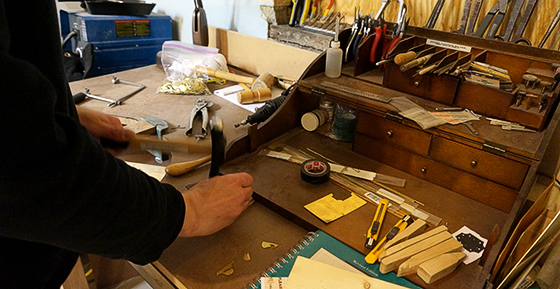
“It’s like a gym membership, but for tools.”
That’s my go-to explanation for what the Lansing Makers Network (LMN) is all about. My gym membership analogy isn’t accurate, though. What LMN really is is a community. A group of like-minded who people got together and decided to launch a “makerspace” (or “hackerspace”) where members could work side-by-side to make and use tools, share resource and ideas, and learn from one another.
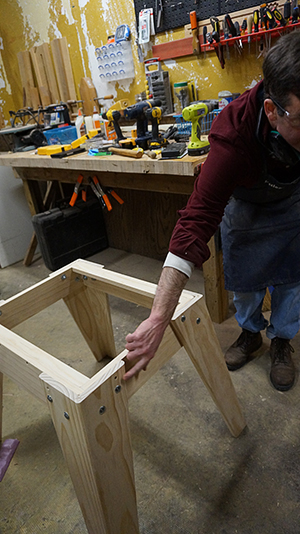
Once finished, this table will be the home for a newly-donated power tool.
If you’re not familiar with the term “maker,” it has become a catch-all word for people who make things. Your dad’s buddy who spends his days in his garage wood shop. The college student who knits strange new patterns to sell on Etsy. (Really, pretty much everyone who sells what they make on Etsy.) Your friend who constantly comes up with creative new ways to use her Arduino. Your cousin who makes ukeleles in his basement. We all know that someone, or we are that someone. Now these and other do-it-/make-it-yourself hobbyists are are collectively referred to as the maker movement, and the whole idea has become so popular that last year the White House hosted a Maker Faire (complete with an “e” on the end of Faire).
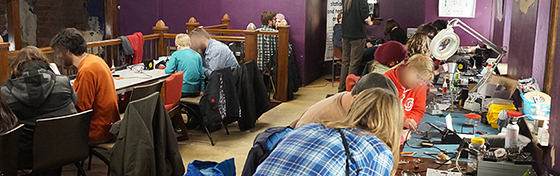
I first learned about the Lansing makers at the Detroit Maker Faire a few years ago. They had a fully functioning, life-size Operation game that used kitchen tongs instead of tweezers — something that awesome gets your attention and sticks with you. That game is now housed in their current location, the beautifully decaying Old Town Temple Building. I’ve been on a few tours, including one with the Michigan Girl Geeks, and I know a member who will sometimes use the laser cutter to get me started on a wood or felt project if I ask him nicely, but before this past weekend I hadn’t had a chance to actively participate in an activity at the space. On Saturday, I finally had a chance to join in one of their workshops: a soldering class. My Valentine and I were one of more than a dozen “couples” (several were parent/child groupings) who, in honor of the holiday, put together a little blinking heart covered with red LEDs.
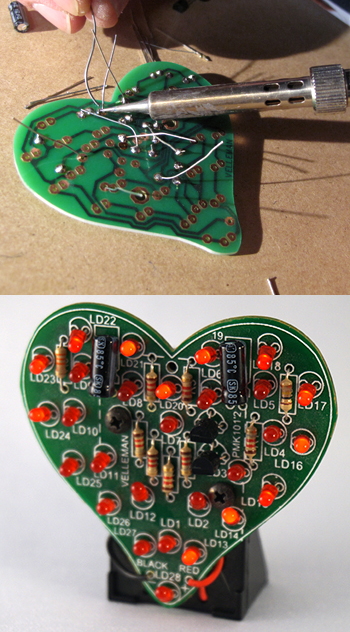
My partner and I made this sweet little LED-covered heart that blinks in patterns.
The Makers are serious about keeping up the spirit of operating as a nonprofit, hosting low- or no-cost educational opportunities that are open to the public, including regular soldering classes, jewelry making, basic electronics, and tutorials to use some of the space’s machines. They also make meeting space available to an individual member’s club or nonprofit.
It costs $50/month for access to coding and crafting materials (including 3-D printers, sewing machines, soldering stations, and the laser cutter) or $80/month to become an all-access member, which also includes metal and woodworking machines like a lathe, power saws, a CNC router, and a CNC mill. Since the space is member-directed, new tools and focus areas will be added based on members’ interests. Once they move into a new space later in the year, they will have a kiln, welding and metal-working torches — tools that they can’t use around all the beautiful wood in the Temple Building.
Safety classes or checkouts are required before you can use the machine shop tools. All members get a passkey with 24/7 access to the building (though I can’t imagine wanting to be alone in the Temple Building after hours — that place is spooky after dark).
I’ve heard a few complaints that you can’t just buy daily passes, but I don’t think that would work. The space is entirely volunteer run, meaning volunteers are spending their own time showing you how to use the tools, some of which have a pretty steep learning curve. I don’t think it’s fair to ask them to do that if you’re not willing to invest in the collaborative space. Also, they need to pay the bills, and heating a space that big isn’t cheap. Tools need to be maintained and repaired. Donated tools often require extensive repairs before they are even usable. If you want the space to stay open and available, I think it’s fair to ask people to do their part.
Unfortunately for me, my work schedule and commute aren’t leaving me much free time to join, but I will be doing so later in the year and I can’t wait to learn how to use all the tools. In the meantime, I’ve become a donor (and you can, too) because little communities like the LMN are one of the great things about living in Lansing.

Deconstructed bowling alley flooring will become a top for the table base pictured above. This is the same bowling alley that was turned into the tables at Zoobie’s.
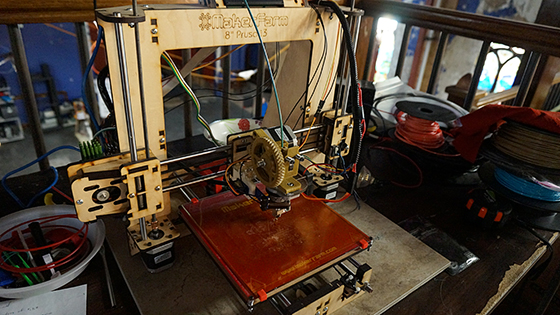
A 3D printer is being used to make parts for a new 3D printer.
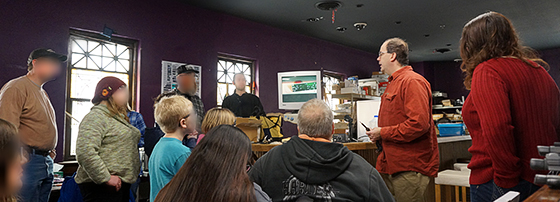
Instructor Mike Flaga gave attendees details and a demonstration about how to solder (above) and then cut us loose to work on our projects (below).
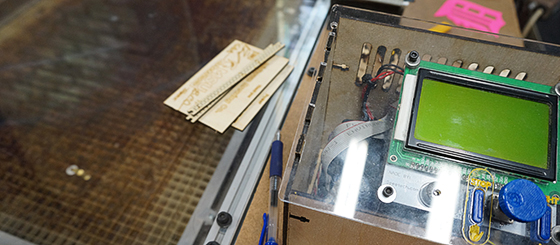
My favorite tool: the laser cutter.
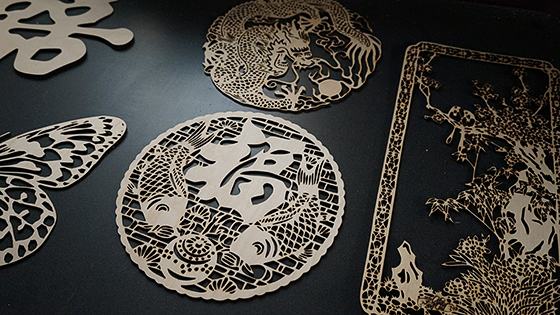
A few sample pieces cut out on the laser cutter.
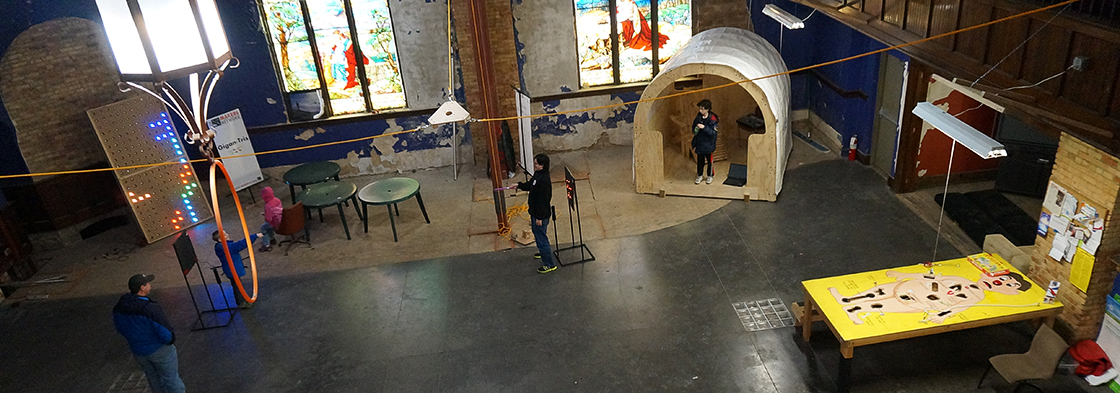
Giant Tetris and Operation games on the Maker Space main floor.
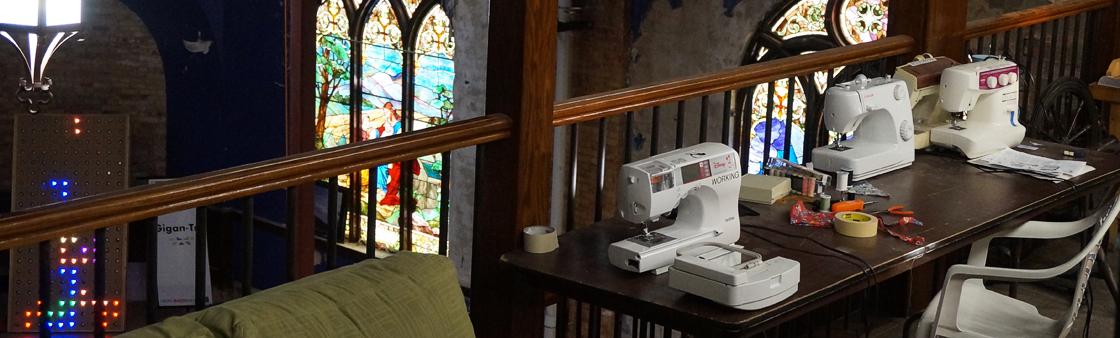
There’s an old-fashioned spinning wheel hidden in the far right corner of the crafting area. I spotted two of them.
 my love letter to lansing